
Diamond Tools -
Diamond Tools
PDC bits are manufactured with a tungsten carbide crown imparting a much superior wear resistant than equivalent steel headed bits.
Specially developed dome-shaped cutters are incorporated into majority of drill bits due to this type of cutter having excellent impact absorbtion than standard flat cutters. Each PDC cutter has a built in side and back rake, which cuts more evenly and with less torque and vibration. Thus the dome cutter is less susceptible to heat damage and does not suffer edge chipping to the same extent as the flat cutter.
The PDC drill bit has been used extensively in the open cast coal exploration drilling achieving bit life of 10 – 20 times greater than roller cone bits with a penetration rate factor of 2-3 times greater.
Similarily in grout-hole drilling tungsten carbide roller bits had been effective only to limited depths and when unforseen hard bands such as ironstone was encountered. This meant that the drill string had to be extracted and bit changed resulting in significant non production.
The hard bands present no barrier to the PDC drill bit allowing operators to maintain the production schedule. This can be highly significant in grouting operations involving hundreds of holes.
PDC bits produce large volume of cuttings due to the speed of penetration and operators should ensure that flush volumes are adjusted to keep the bit face clean and cooled.
Product Photos
The surface of the disc-shaped cutting element consists of very fine synthetic diamond particles sintered together by a high pressure, high temperature process. Backing this diamond layer is a tungsten carbide stud which is brazed directly into the bit matrix by a special process. These cutters can take the enormous compressive and shear loads generated during drilling without failure or erosion.
PDC core bits are ideal for use on high powered drills at relatively low rotation speeds. Remarkable results have been obtained both in bit life and penetration compared with surface set bits. Core recovery is also enhanced due to the faster penetration.
PDC core bits may be used with water, mud or air flush.
Two main types of PDC cutters are available such as the conventional flat design and dome.
Product Photos
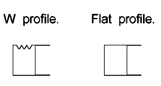 FACE PROFILES
Thin kerf bits (e.g. TT, T2, and T6 range) are manufactured in flat profile and thicker kerf bits (e.g. DCDMA and Wireline) in W profile.
WATERWAYS
The number and depth of waterways is optimised for the formations to be drilled.
DEPTH OF IMPREGNATION (D.I.)
Core bits are manufactured in two standard depths of impregnation: 4 mm and 6 mm...
FACE PROFILES
Thin kerf bits (e.g. TT, T2, and T6 range) are manufactured in flat profile and thicker kerf bits (e.g. DCDMA and Wireline) in W profile.
WATERWAYS
The number and depth of waterways is optimised for the formations to be drilled.
DEPTH OF IMPREGNATION (D.I.)
Core bits are manufactured in two standard depths of impregnation: 4 mm and 6 mm...
Product Photos
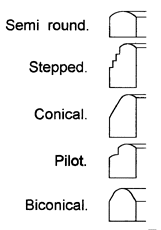 FACE PROFILES
Semi Round : Standard profile. Very strong in hard broken formation.
Stepped :High penetration and stability but fragile in hard fractured formation.
Conical :Good penetration rate and stability. Stronger than stepped profile.
Pilot : Good core recovery in soft, friable formation especially when used with face discharge. Good stablisation but fragile nose.
Biconical :Only used on thick kerf core bits in soft unfractured formation.
FACE PROFILES
Semi Round : Standard profile. Very strong in hard broken formation.
Stepped :High penetration and stability but fragile in hard fractured formation.
Conical :Good penetration rate and stability. Stronger than stepped profile.
Pilot : Good core recovery in soft, friable formation especially when used with face discharge. Good stablisation but fragile nose.
Biconical :Only used on thick kerf core bits in soft unfractured formation.
Product Photos
Reaming Shells:
Reaming shells are designed to be placed behind the core bit to ensure hole diameter is maintained and to assist core barrel stabilization.This ensures that when a new core bit is inserted into a continuing bore hole there is a good chance of reaching bottom of bore hole without reaming.
Reaming shells are produced with diamond panel pads using specially chosen diamonds of 30/40 s.p.c. Although reaming shells generally last 3 – 4 times longer than core bits they should be retired as soon as they wear under gauge otherwise it could result in an undersize bore hole diameter which can mean reaming later
Reaming shells are available for all types of core barrels
Casing Shoes:
Casing shoes are used for drilling down or positioning casing tubes in a drilled hole. The interior is smooth and sufficiently large enough to allow free passage of drill bits, core bits, reaming shells and core barrels having the same letter-name designation (e.g. HW casing accepts HWF, HWG and T6-H core barrels).
Impregnated casing shoes are recommended for very hard and fractured formations whilst Tungsten Carbide casing shoes are recommended for soft to medium hard formations.